social-identity-comic

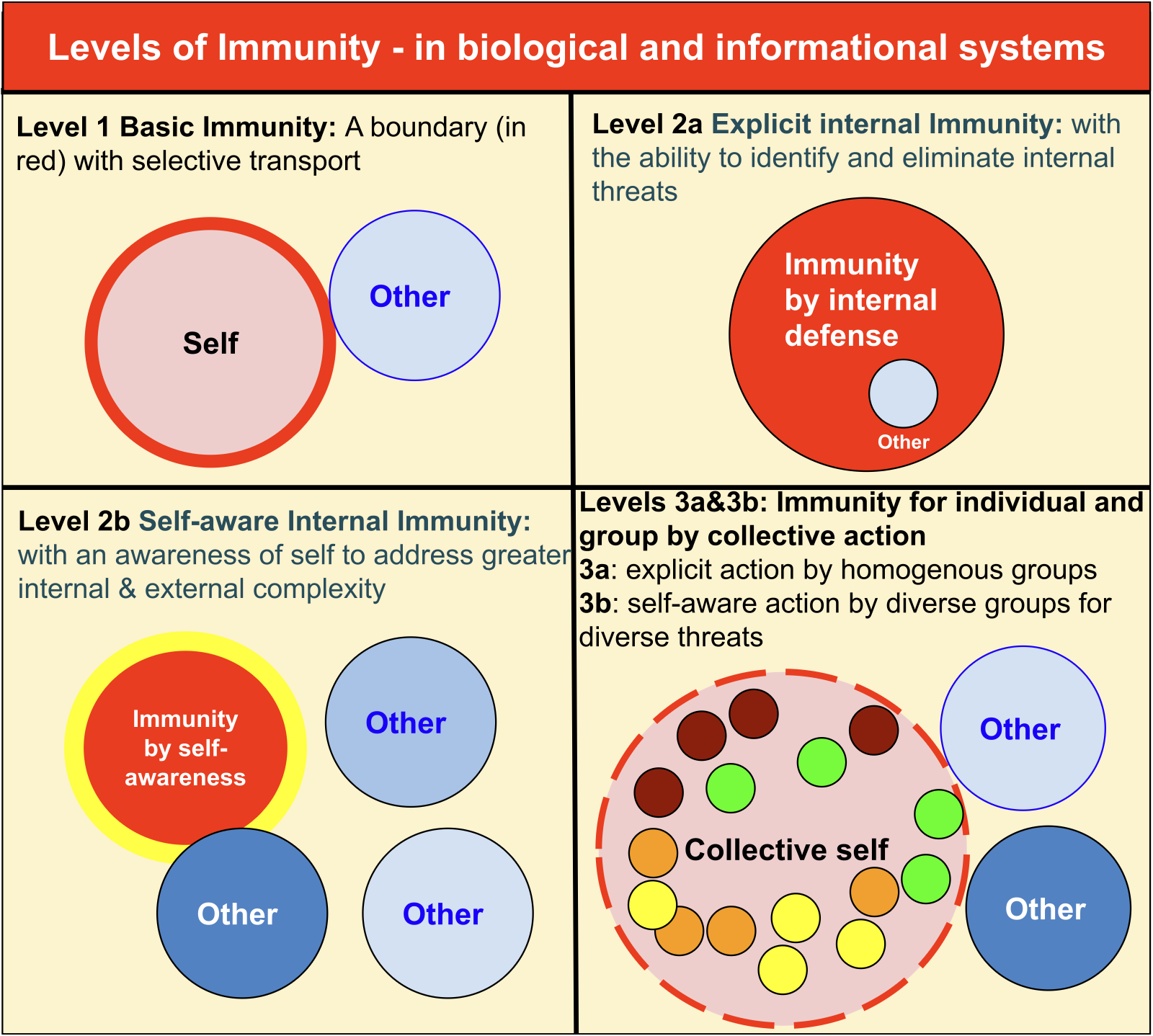
The Evolution of Immunity framework proceeds through six levels

Level 0 (not shown above) is the absence of a localized entity — a pre-self state where no boundary exists between self and environment.

Level 1 introduces boundary immunity: a physical or functional barrier that defines self by excluding non-self.

Level 2a adds pattern-based immunity – an internal defense mechanisms that recognize threats through fixed patterns — e.g., innate immunity in biological systems or signature-based detection in cybersecurity.

Level 2b adds adaptive immunity, a self-model that enables learned, specific responses to novel threats — e.g., the adaptive immune system — a biological self-awareness in vertebrates — or AI systems capable of self-monitoring or model-based threat assessment.

Level 3a adds collective pattern-based immunity, where groups coordinate defenses through pre-programmed responses without a shared self-model – e.g., social insects or distributed network defenses.

Level 3b adds collective adaptive immunity, where a group develops a shared self-model that enables coordinated, adaptive collective defense – e.g., social organisms and human institutions and maybe AI someday.

Resources for the Framework of Evolution of Immunity

Evolution of Immunity in Biological and Informational Systems

A framework for the evolution of immunity based on the tension between self and other – causing the creation of new immune functions independent of biological or informational substrate.  Applications to understanding polarized social groups, evolution of Artificial Intelligence (AI), and consciousness.

How Immunity of Self from Other Drives Evolution
Based on how the evolution of localization and immunity increases the likelihood of survival of an entity and groups of entities, a multi-level framework is developed for understanding immunity as a substrate-independent developmental process.
The framework reveals parallels in the evolution of immunity across biological and informational systems from single-celled organisms and their molecular defenses to social entities and their collective immune responses, including the emerging domain of artificial intelligence safety.
The increased functionality of immunity of self from others is the core theme at each level of immunity – independent of the biological or informational substrate.
Applications of the framework of the evolution of immunity include a theory of the origin of human consciousness and predictions for the evolution of artificial intelligence (AI).
Isn’t Immunity already in Evolutionary Theories? 
Immunity in evolutionary theory is compartmentalized. In immunology and philosophy of biology, the self/non-self distinction is treated as a mechanism for evolutionary transitions to individuality. Studies of sociality have extended immune logic to collective defense. In evolutionary psychology, self-other discrimination is studied as an evolved cognitive adaptation. Yet in general evolutionary theory — population genetics, quantitative genetics, major transitions frameworks — self-vs-other and immunity are not formal concepts.
Immunity remains characterized as a “context-dependent motif”: recognized in specific subfields but absent from the general theoretical apparatus. This framework of the evolution of immunity  proposes to change that status — from motif to mechanism — by showing that
Immunity is not merely a defensive byproduct of evolution but a developmental process that drives functionally– expressed by common evolutionary transitions across both biological and informational systems.